Let a brief become a contract you can send.
Drafted to match the deal, not stamped from a template.
Almost any agreement, drafted in full.
Whatever the agreement type.Drafted in the form it's normally read.
Working together
When ideas, work, or trust begin to flow.
- Confidentiality
Mutual & one-way NDA
Before a roadmap is opened.
- Independent work
Freelance & contractor
A one-off project or an ongoing book of work.
- Advisory
Consulting & advisory
An independent expert taking an engagement.

Exchanging value
When the deal itself is the document.
- B2B services
Services agreement
Master terms once, statements of work per engagement.
- Licensing
Licensing & distribution
When the right to use is what's being sold.
- Commerce
Sales & purchase
Goods, assets, or a business changing hands.

Long-term commitments
When the contract holds for years and reshapes both sides.
- Hiring
Employment & offer letter
The start of a tenure, not a transaction.
- Property
Commercial lease
Office, studio, or retail, for a term of years.
- Co-founding
Partnership & joint venture
Two or more parties building together.
Not fill-in-the-blanks. Drafted clause by clause.
An attorney's structure.Each section structured for your situation.
Mutual Non-Disclosure Agreement
Effective Date: April 15, 2026
This Agreement is entered into by and between Acme Corporation, a Delaware corporation (“Party A”), and Northwind Labs Ltd., an England and Wales company (“Party B”).
Whereas, the parties wish to explore a potential business relationship and may disclose certain confidential information to each other in connection therewith.
- 1.Definitions. “Confidential Information” means any non-public information disclosed by one party (the “Disclosing Party”) to the other (the “Receiving Party”), whether oral, written, or electronic.
- 2.Use Restrictions. The Receiving Party shall use Confidential Information solely to evaluate the potential business relationship and shall not disclose it to any third party without prior written consent.
- 3.Term. This Agreement continues for three (3) years from the Effective Date, unless terminated earlier on thirty (30) days’ written notice.
In Witness Whereof, the parties have executed this Agreement as of the Effective Date.
Governed by the laws of the State of California, without regard to its conflict-of-laws principles.
- I
Parties & recitals
Full legal names, entity types, addresses, and the recitals that explain why the parties are contracting.
- II
Defined terms
Capitalized terms — “Confidential Information”, “Services”, “Effective Date” — defined once and used consistently throughout.
- III
Operative clauses
Scope, payment, IP, term, termination, indemnification — numbered in the order this kind of agreement is conventionally laid out.
- IV
Governing law & signatures
Jurisdiction, venue, dispute resolution, and a signature block ready for both parties — name, title, date.
Three turns from deal to draft.
Describe what you want.The workspace handles the rest.
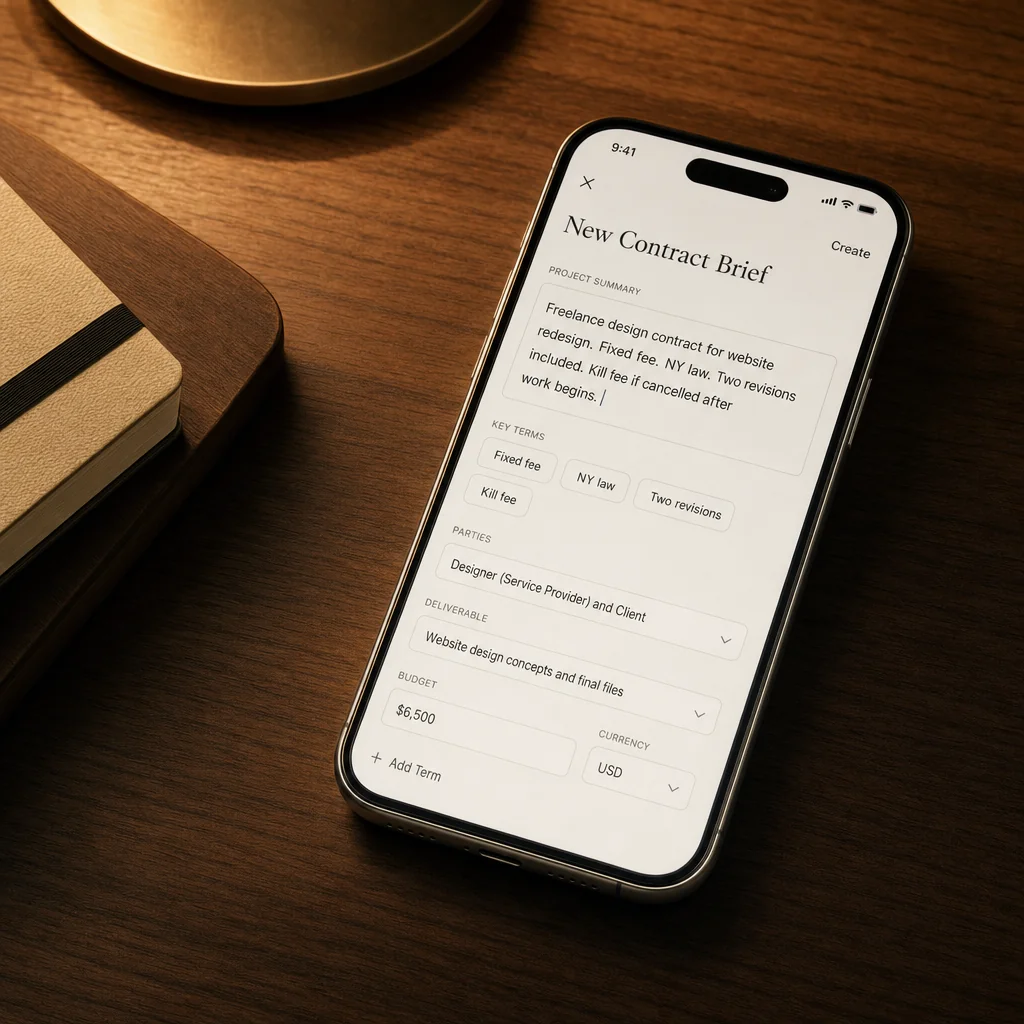 Describe
Describe the deal.
Parties, scope, term, payment, jurisdiction — plus anything non-standard (a kill fee, a most-favored-nation clause, an unusual termination trigger). The more specific you are, the closer the draft lands.
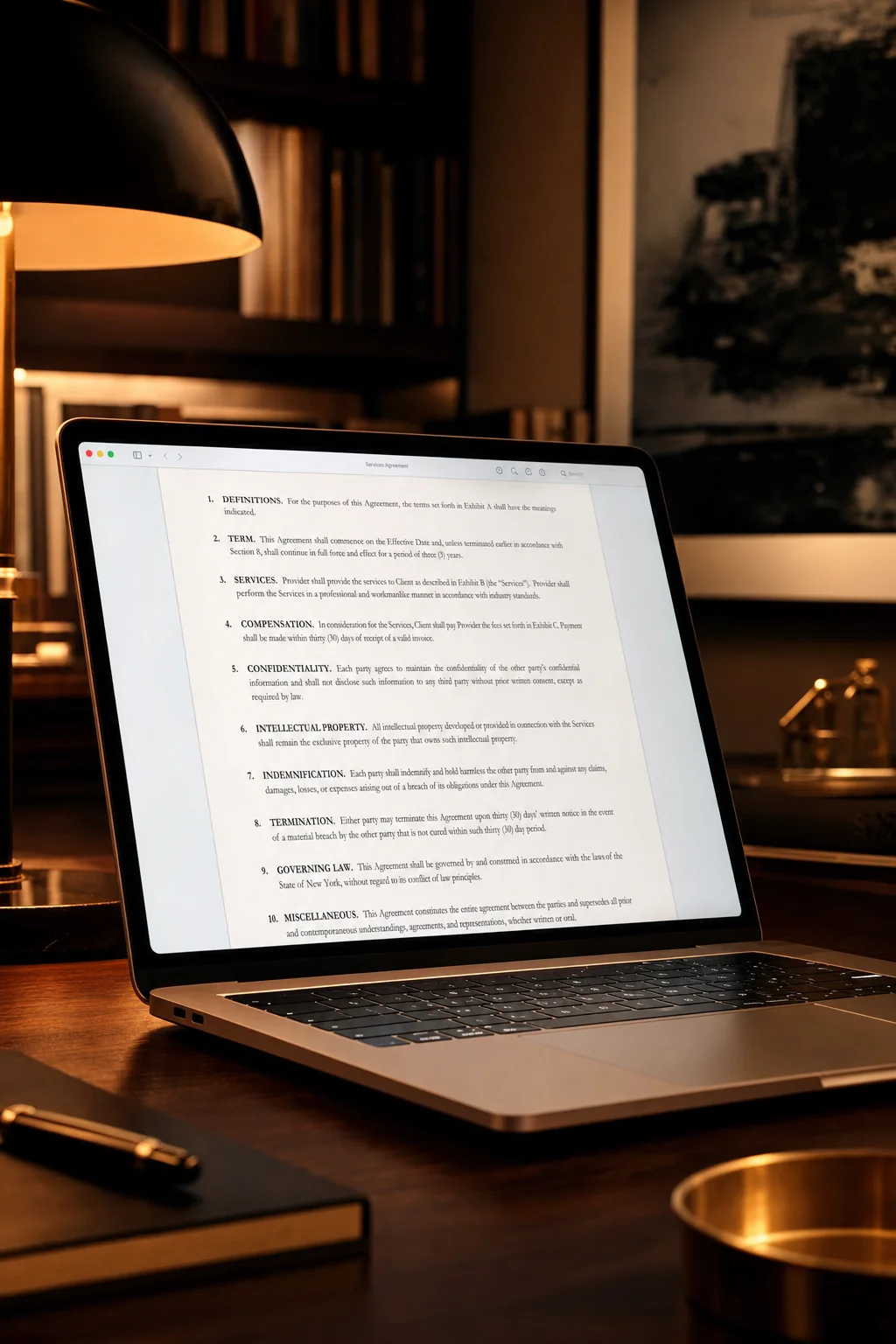 Draft
DraftGreatars drafts the agreement.
A complete document arrives in the workspace — properly structured for the type of agreement, with the clauses you'd expect for the situation you described.
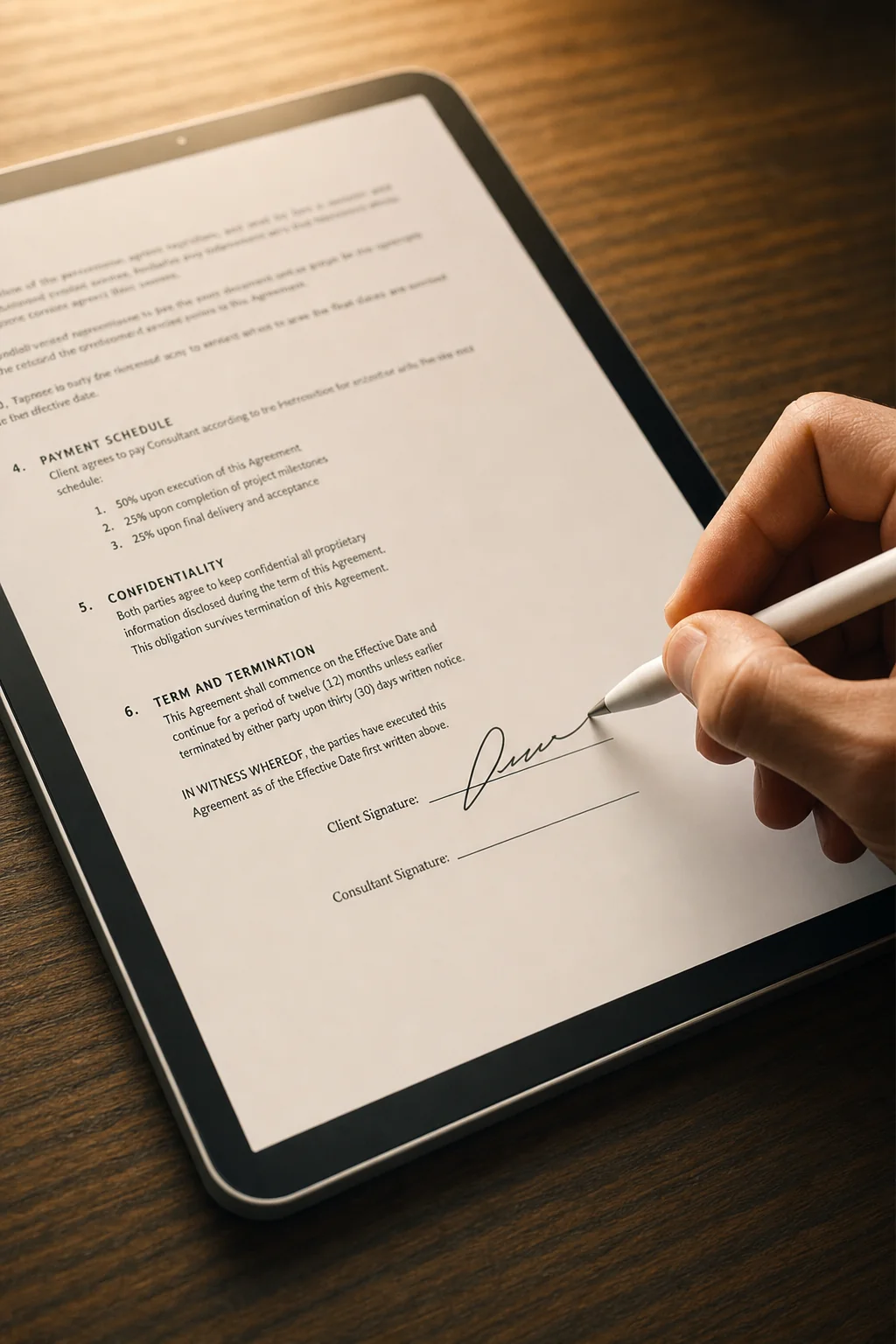 Review & send
Revise, export, send.
Ask for clause-level edits in plain English — “make the termination clause mutual”, “tighten the IP assignment”. Export as DOCX or PDF when it's ready.
A template is paper. This is the reasoning behind the paper.
Templates handle what doesn't change.Greatars handles what does.
- Jurisdiction is not a dropdown
Tell the drafter the law that governs and the venue for disputes; the document picks the right phrasing, conflict-of-laws language, and any clauses required for enforceability in that jurisdiction.
- Defined terms stay consistent
Every capitalized term is defined once and used consistently through the document. No “Services” in one clause and “the Work” in another — an inconsistency templates can't catch.
- Non-standard terms get written, not omitted
Asked for an MFN clause, a kill fee, a sublease carve-out, an equity acceleration on change-of-control? Those land as their own numbered clauses, drafted to match the agreement's voice — not stapled on as appendices.
- What's missing is flagged
If the brief is silent on something that should be decided — assignment, dispute resolution forum, post-termination obligations — the workspace surfaces it instead of quietly picking a default.
Frequently asked questions.
A contract's enforceability depends on the elements of a binding agreement — mutual assent, consideration, capacity, legality — not on the tool that drafted it. A well-drafted document that both parties knowingly sign can be binding. For anything high-value or unusual, have it reviewed by a qualified attorney in the relevant jurisdiction.
Drafts produce well-structured agreements with the clauses appropriate for the situation described. They will not catch jurisdiction-specific traps, recent statutory changes, or the unique circumstances of your deal. Treat the output as a strong first draft, not a final document.
Yes. You land in a full document workspace where any clause can be edited directly. You can also ask the workspace to revise specific sections — for example, “make the termination clause mutual”, “add a 30-day cure period”, or “narrow the IP assignment to work product only”.
You can specify any jurisdiction in the brief — common law, civil law, or a specific state, province, or country. The draft uses appropriate governing-law and venue language. For locally-required clauses (such as specific consumer-protection or labor disclosures), have a local attorney confirm compliance.
DOCX, PDF, and Markdown. DOCX preserves the numbered clause structure for review in Word or Google Docs. PDF is signature-ready. Markdown is useful if you want to keep the contract in a docs repository or pipe it into another tool.
Templates leave blanks for the easy parts (names, dates, amounts) and fix the hard parts in advance. A drafted document does the reverse — it writes the hard parts to match the situation and uses standard phrasing for the routine parts. The non-standard clauses are where templates fail and where drafting helps.
For internal use, vendor onboarding, NDAs, freelance work, and standard services agreements, drafts are typically usable after a careful read-through. For acquisition agreements, financing documents, regulated-industry contracts, or anything that materially shifts liability, draft first then take it to counsel — the draft makes the counsel review faster and cheaper, but does not replace it.
Briefs and drafts are processed securely. Greatars does not share contract content with third parties. For highly sensitive matters, the workspace can draft with placeholder names; you replace them with real parties after download.